

Create Membership Website That Actually Succeeds
To really win with a membership site, you have to stop thinking about one-off sales and start building long-term value. It's a completely different mindset.
Instead of constantly hunting for the next transaction, you're creating a predictable, recurring income stream by building a loyal community around your work. Think of it as the difference between selling a book and running a book club. One is a transaction; the other is an experience.
Why a Membership Website Is Your Smartest Move
The creator economy is getting smarter. Selling individual digital products like e-books or single courses is a good start, but it often traps you in an exhausting cycle of launches and promotions. You make a sale, and then you’re right back at square one, looking for the next customer. It's a tough way to scale and almost impossible to predict.
A membership website completely flips that script. You're no longer focused on single purchases. Instead, you're building a sustainable business around relationships and continuous value. It’s a strategic move that brings stability, forges a much deeper connection with your audience, and ultimately, gives you back your freedom.
Predictable Revenue and Financial Stability
The biggest win here is the move to recurring revenue. When members pay a monthly or annual fee, your cash flow suddenly becomes reliable and predictable. This financial stability is a game-changer. It lets you plan for the long term, invest in better content, and sleep better at night during slower sales months. You’re finally off the revenue rollercoaster of endless launches.
And the global trend is screaming this from the rooftops. The subscription economy hit a massive $487 billion in 2024 and is on track to explode to over $2.1 trillion by 2025. Subscription businesses are growing five times faster than S&P 500 companies. This isn't just a fad—it's the future.
Fostering a Genuine Community
A membership site is so much more than a content library; it’s a home for your people. It’s your chance to build a real community where members can connect with each other, learn, and grow together. That feeling of belonging is an incredibly powerful reason for people to stick around.
When you bring your courses, discussions, and resources under one roof, you create a powerful, unified experience for your brand. This stops your audience from getting scattered across random platforms like Discord or a Facebook Group, which skyrockets engagement and member lifetime value.
Amplifying Your Authority and Brand
Running a membership site positions you as the go-to expert in your niche. By consistently delivering high-value content, you build incredible trust and authority. An all-in-one platform like Zanfia pairs total brand control (white-labeling, custom domain) with an AI team that actually runs the work: the assistant knows the whole application and can act on it by chat or by voice, and any workflow you set up can also be driven by outside agents through the MCP endpoint (available on higher plans, see the current Zanfia pricing). Your members see your brand, not the platform's, and you spend your time on the work only you can do.
To see just how powerful this can be, check out our deep dive into recurring revenue business models.
Let’s quickly break down how this model stacks up against the old way of doing things.
Membership Model vs Traditional Sales
| Feature | Membership Website (e.g., Zanfia) | Traditional E-commerce |
|---|---|---|
| Revenue Stream | Predictable, recurring (monthly/annual) | Unpredictable, one-time sales |
| Customer Relationship | Long-term, community-focused | Transactional, short-term |
| Business Focus | Retention and ongoing value | Customer acquisition and single sales |
| Financial Stability | High, consistent cash flow | Low, "feast or famine" cycles |
| Community | Integrated and central to the experience | Often non-existent or fragmented |
| Brand Control | Full ownership of brand and experience | Often diluted by marketplace branding |
Ultimately, a membership model isn't just a different way to sell—it's a fundamentally better way to build a sustainable business as a creator.
Laying the Foundation for a Thriving Membership
Let's be honest. Jumping straight into building your site without a solid plan is a fast track to wasting a ton of time and money. The creators who really succeed don't just build a product; they build a solution for a very specific group of people.
The foundation of a profitable membership has nothing to do with the tech. It’s about the clarity you have before you even think about content or platforms. This is where you make the big calls that will define everything that comes next.
It all boils down to knowing who you serve, what unique value you bring to the table, and how you’ll package it all up to solve their biggest problems.
Pinpoint Your Ideal Member and Niche
Before you can build anything, you have to know exactly who it’s for. A vague audience gets you vague results. It's that simple.
Start by getting ridiculously specific about your ideal member. What are their real goals? What are the frustrating challenges that keep them up at night? What have they already tried that just didn't work?
This isn’t just a thought exercise. It’s how you go from a broad, crowded topic like "fitness" to a specific, defensible niche like "strength training for busy parents over 40." When your niche is that tight, you can speak directly to their pain points, making your offer feel like it was tailor-made just for them.
The goal isn't to be a generic resource for everyone. It's to become the undisputed go-to expert for a very specific group.
Craft an Irresistible Value Proposition
Once you know your who, you need to define your what. What are you offering that they can’t find anywhere else? This is your value proposition—a clear, compelling promise of the value someone gets the moment they join.
It’s the simple answer to the question: "Why should I join your thing instead of someone else's, or just doing nothing at all?"
A strong value proposition isn't a laundry list of features like "access to videos and a community." It's a statement of transformation. For example, instead of saying, "Get access to our business courses," you say, "Launch your first digital product in 90 days with our proven roadmap and a community of creators to keep you accountable."
See the difference? You're shifting from features to outcomes, and that's what makes joining a no-brainer. To really nail this, you can learn more about what a value proposition is and how to build a powerful one.
This whole process is a simple, powerful flywheel: you build an audience, offer them a solution, and create a sustainable income stream.
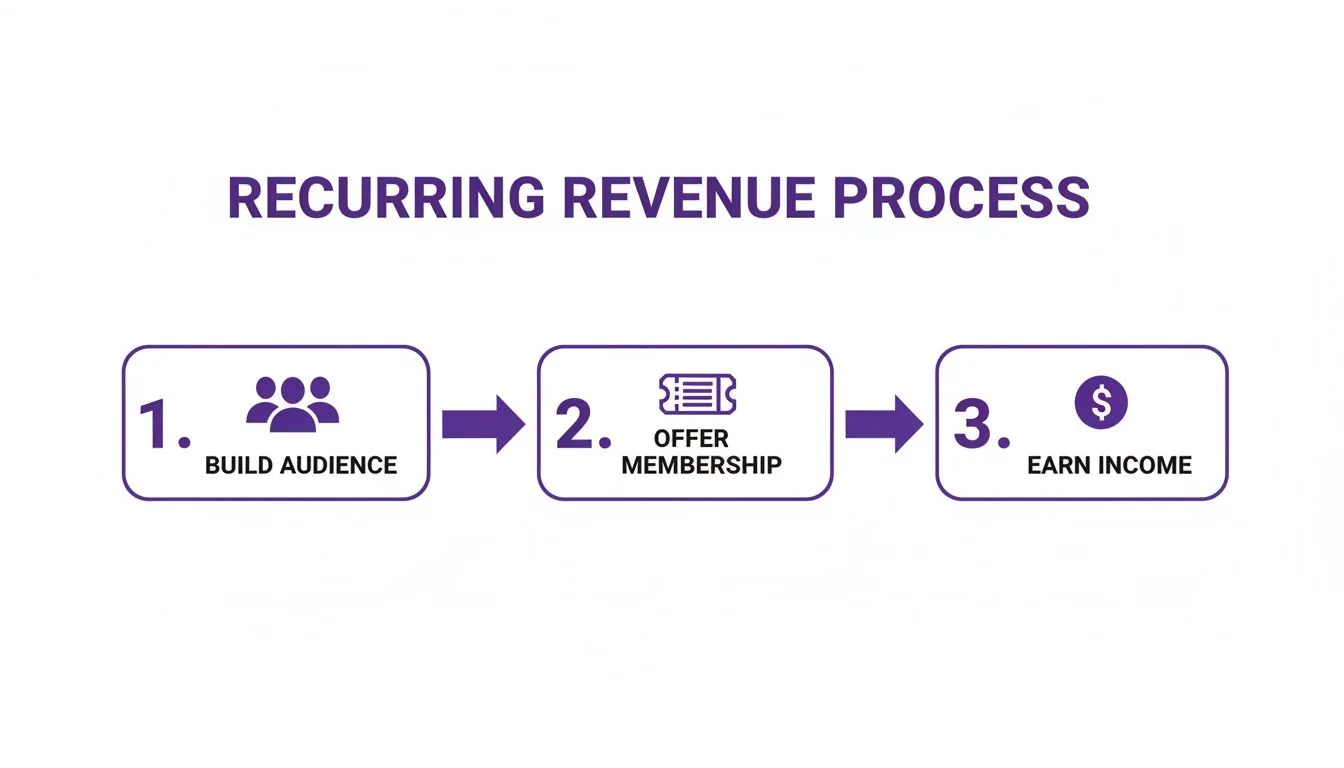
This flow shows that a great membership is built on a real relationship, not just a transaction.
Structure Content That Solves Real Problems
Okay, you've got your ideal member and a killer value prop. Now you can finally start outlining your content. The trick is to structure your offerings to directly tackle the problems you already identified. This is where a flexible, all-in-one platform becomes your best friend, letting you mix different formats to create the perfect solution.
Think about combining a few different content types to hit every angle:
- Online Courses: Give members a structured, step-by-step path to a specific result. Look for platforms with native video hosting—it saves you a surprising amount of money and hassle by eliminating the need for services like Vimeo or Wistia.
- Community Spaces: This is huge. Give people a place to connect, ask questions, and get support from you and each other. When the community is integrated with your courses, like it is in Zanfia, engagement goes through the roof because everything is in one place.
- Digital Downloads: Offer quick wins. Think templates, e-books, or checklists that your members can use right away to get an immediate result.
- Paid Newsletters: Deliver exclusive insights and curated content directly to your most dedicated followers. It's a fantastic way to stay top-of-mind.
By using a multi-faceted approach, you're delivering continuous value. And that, right there, is the secret to keeping your members sticking around for the long haul. This foundational work is what separates the memberships that thrive from those that fizzle out.
Structuring Content and Pricing for Maximum Value
Okay, you’ve nailed down your audience and your core promise. Now for the fun part: building out the structure that turns curious followers into paying members. This is where you design your content tiers and pricing—it’s the engine of your entire membership business.
Getting this right isn’t just about picking random numbers. It’s about creating a clear journey that makes people want to join, stick around, and even upgrade. The way you package everything is a direct signal of its value. Make it easy for them to see what they get, and they’ll happily pay for it.
Choosing the Right Membership Model
There are a few tried-and-true models out there, and the best fit really depends on what you’re offering. The goal is to give people options that make sense for them right now.
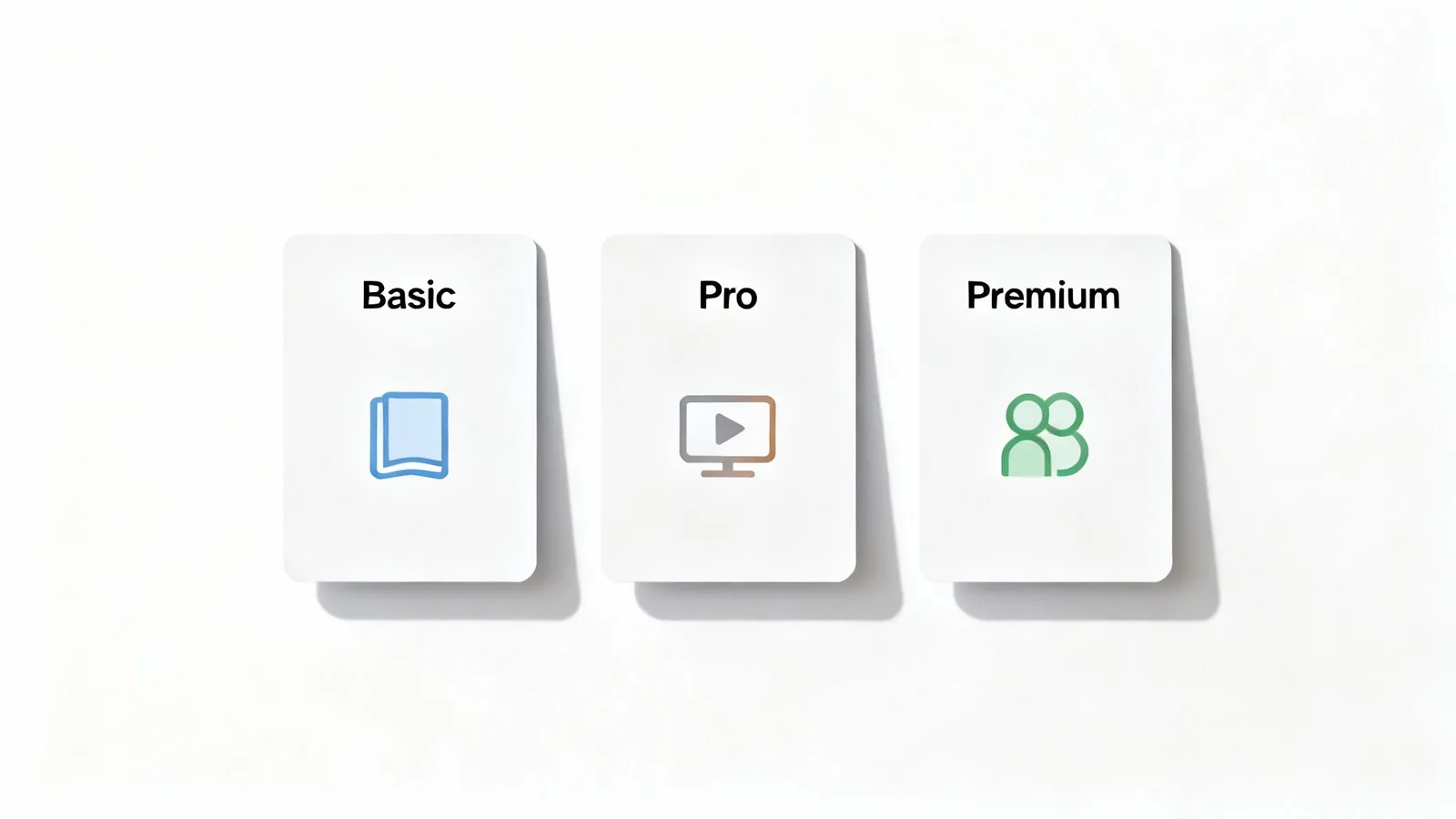
- Tiered Access Model: This is the classic for a reason. You create a few levels—think Basic, Pro, Premium—each unlocking more content and perks. Your "Basic" tier might be a great entry point with community access, while "Premium" could offer everything plus direct coaching. It gives your members a clear path to grow with you.
- All-in-One Subscription: Simple. Powerful. One price gets you everything. This model is perfect if you want to deliver overwhelming value and make the buying decision a no-brainer. No confusion, just pure access.
- Pay-Per-Product Model: While not a pure subscription, this is a killer part of a smart strategy. It lets you sell individual courses, workshops, or guides. It’s a fantastic way to attract new customers who aren't ready for a recurring commitment but will pay to solve a specific problem. A platform like Zanfia is built for this, letting you sell one-off products across 12 product types (courses, communities, newsletters, downloads, consultations, bundles and more) under one brand, then gently nudge those happy customers toward your full membership.
Here's a pro tip: You don't have to pick just one. The most successful memberships often blend these models. You might have your all-in-one subscription as the main offer but also sell a high-value "starter" course to bring new people into your world.
Flexible Monetization Tools That Drive Growth
To actually build these models, you need a platform with the right tools in its belt. Modern systems offer much more than a simple monthly charge, letting you match your offers to how people actually like to buy.
Make sure your platform can handle things like:
- Subscriptions: The bedrock of your recurring revenue. Monthly or annual options are a must.
- Installment Plans: This is a game-changer for high-ticket offers. A single $500 payment can be intimidating, but splitting it into five monthly payments of $100 feels way more doable. You'll see your conversion rates jump.
- Bundles: Group related products together. A course, an ebook, and a month of community access? That’s a powerful package that instantly increases the perceived value.
- Order bumps and upsells: Offer a relevant add-on right at checkout, or a subscription upsell at the same step. It’s one of the easiest ways to increase the value of every single sale.
- Test mode checkout: Buy your own product end-to-end before launch. Test orders are tagged and hidden from your real order list, so you verify the whole flow (including tracking) without polluting your data.
And if you're creating educational content, take the time to learn the best practices for online courses. Applying these principles will make your material so much more valuable and effective for your members.
The Hidden Cost of Platform Fees
Finally, let’s talk about something that can quietly eat away at your profits: transaction fees. A lot of platforms skim a percentage off every single sale you make, often anywhere from 5% to 10%. It might not sound like much at first, but it adds up—fast.
Imagine your business is bringing in $5,000 a month. A 10% platform fee costs you $500 every single month. That’s $6,000 a year that vanishes before it ever hits your bank account. Money that could have been reinvested in marketing or paid out as profit.
This is exactly why a 0% platform transaction fee model is so powerful. Zanfia works differently, as of the current pricing: you pay a flat SaaS subscription starting at $39/month (or $31/month billed annually) on the Starter plan, and you keep 100% of your customer revenue. The only cut goes to the payment processor (Stripe or PayPal, roughly 2.9% + $0.30 in the US). For a creator doing $5-10k a month, that's thousands of dollars a year staying in the business instead of leaving it. See the current Zanfia pricing for the full plan comparison.
If you want to dive deeper into this, check out our full guide on subscription pricing strategies. It's a structure designed to help you grow, not to take a bigger cut as you succeed.
Choosing Your Tech Stack Without the Overwhelm
Let's be honest: technology is often the biggest hurdle that stops talented creators from ever launching. The fear of picking the wrong tools, wrestling with a dozen plugins, or breaking something critical is real. It's the classic fork in the road—do you try to piece together a DIY solution, or do you go with an integrated, all-in-one platform?
The DIY route, usually built on WordPress, looks tempting at first glance. It seems flexible, and the initial costs feel low. But that path is littered with hidden costs, and I'm not just talking about money. I’m talking about your most valuable resource: your time.
Every new feature means hunting down another plugin. Before you know it, you're juggling separate tools for memberships, courses, payments, and your community. None of them were actually designed to play nicely together, which leads to inevitable conflicts, security holes, and hours spent troubleshooting instead of creating. This is what we call technical debt, and it just keeps growing, slowly draining your energy.
The All-in-One Advantage
An all-in-one platform is designed to wipe all that chaos off the table. It’s a single ecosystem where every piece—courses, community, e-commerce, and payments—is built from the ground up to work together. No plugins to update. No conflicts to resolve. No security patches to worry about on a Saturday night.
For creators, this translates directly into peace of mind. Zanfia goes a step further: instead of you configuring every setting, an AI team is doing the work inside the product. The assistant knows the whole application and can perform any action available in the interface, by chat or by voice, so you dictate what you want and it happens. Powerful automations save creators an average of 5-10 hours a month on administrative busywork alone. That’s time you can pour back into creating amazing content or engaging with your community.
The most successful creators I know aren't IT experts, and they don't try to be. Their job is to deliver value. A unified tech stack removes the friction between your big idea and your members, letting you operate with clarity and confidence.
When you're weighing your options, thinking about the long-term is key. A deep-dive comparison like this one on Webflow vs WordPress can really help clarify which strategic direction makes the most sense for you.
Platform Comparison: All-in-One vs. DIY WordPress
To make this choice crystal clear, let's put the two approaches head-to-head. It's not just about features; it's about what you're signing up for day-to-day.
| Aspect | Zanfia (All-in-One) | DIY WordPress Stack |
|---|---|---|
| Setup & Maintenance | Zero tech skills needed. All maintenance and security handled for you. | Requires technical knowledge. Constant plugin updates and troubleshooting. |
| Core Features | Courses, community, e-commerce, and payments are fully integrated. AI assistant and voice dictation built in; MCP endpoint for outside agents (plan-dependent, see the current Zanfia pricing). | Requires multiple, often conflicting, plugins for each function. |
| Hidden Costs | Predictable SaaS subscription. 0% platform transaction fees. | Premium plugins, themes, specialized hosting, and developer fees add up quickly. |
| Support | Dedicated expert support focused on creator success. | Relies on community forums or hiring expensive freelance developers. |
| Peace of Mind | High. The system is professionally managed and reliable. | Low. You are responsible for every technical issue and security threat. |
Ultimately, choosing your tech is really about choosing your job title. A DIY approach forces you to become a part-time systems administrator. An all-in-one platform empowers you to be what you are: a creator.
Key Features That Actually Simplify Your Business
Beyond just saving time, the right platform gives you tools that are purpose-built to help you grow. These aren't just little conveniences; they are features that directly impact your member experience and your bottom line.
- Native Video Hosting: Juggling separate, pricey video services like Vimeo or Wistia adds another layer of complexity and expense. An integrated solution with native video hosting simplifies your workflow and cuts costs, while still offering flexible integrations with external services if you really want to.
- A Checkout Built to Sell: Your platform should give you the mechanics that actually lift conversion: order bumps, subscription upsells, installment plans (split a $600 course into four payments), discount codes, and wallet payments like Apple Pay and Google Pay through Stripe and PayPal.
- Test Mode Before You Launch: Run a full test purchase on your own checkout. Conversion events fire to the test surfaces of your tracking (GA4, Meta, TikTok) and are tagged TEST in the events log, so you verify the entire flow without polluting your real data.
- AI Team + MCP Endpoint: The assistant handles work you'd normally click through by hand, and you can also connect outside AI assistants to your workspace over the MCP endpoint (plan-dependent, see the current Zanfia pricing ).
These features aren’t just about making life easier. They're about building a professional, reliable system that works for you 24/7. To see how different systems stack up, check out our guide on the best membership website platforms.
Building a Community That Boosts Member Retention

Let's be honest: fantastic content might get someone to sign up, but it’s the sense of belonging that convinces them to stay for the long haul.
A strong, engaged community is the single most powerful retention tool you have. It transforms your membership from a simple content library into a living, breathing ecosystem where people build real connections.
When members feel seen, heard, and connected to others on the same journey, their loyalty skyrockets. They stop being just customers; they become advocates. This is the secret sauce for dramatically increasing member lifetime value.
Designing Your Community for Engagement
A great community doesn't happen by accident—it's designed with intention. The structure and tools you provide will either spark interaction or let it fizzle out. The key is to create dedicated spaces that serve different purposes, guiding members toward meaningful conversations.
Think about organizing your community with purpose. Platforms like Zanfia allow you to create specific channels for different needs, keeping discussions organized and valuable.
- Topical Discussion Channels: Create spaces for specific subjects related to your niche. This is where members can go deep, share insights, and ask focused questions.
- Announcement Channels: Use a read-only channel for important updates, news, and events. This keeps critical information from getting lost in the noise of general chat.
- Group-Based Organization: Segment members into smaller groups based on their purchase, progress, or interests. This fosters a more intimate, relevant experience.
By creating this intentional structure, you make it easy for members to find what they need and connect with the right people—the absolute foundation of a thriving community.
The Power of an Integrated Experience
One of the biggest mistakes I see creators make is outsourcing their community to external platforms like Discord or Facebook groups. Sure, they're free, but these tools pull your audience away from your core brand and create a disjointed, clunky experience.
Nobody wants to juggle multiple logins and platforms. That friction kills engagement before it even starts.
The real magic happens when your community and your content live in the same place. An integrated system, where course materials and discussion forums are seamlessly linked, creates a unified environment for learning and interaction. When a member has a question about a specific lesson, they can ask it right there, and everyone benefits from the answer.
Keeping everything unified under your own brand is more than just a convenience—it’s a strategic advantage. It keeps your members focused, boosts their engagement with your material, and reinforces the value of their subscription every single time they log in.
The data backs this up. Community-driven memberships can achieve retention rates as high as 85-92%, well ahead of content-only platforms that typically see 60-70% retention. Those numbers tell you everything you need to know about how critical a sense of belonging is for long-term success.
Fostering a Welcoming and Active Culture
Your role as the creator is to be the spark that ignites the conversation. In the beginning, you’ll need to be the most active member—posting prompts, asking questions, and celebrating member wins. Your energy sets the tone for everyone.
A huge part of this is the onboarding experience. When a new member joins, they should feel immediately welcomed and know exactly where to go. An automated welcome email can point them to the right channels and encourage them to introduce themselves.
Hosting member-only events, like live Q&A sessions or virtual workshops, is another powerful way to foster connection. These events make your membership feel exclusive and provide a space for real-time interaction that builds strong bonds. For a deeper look at keeping your members happy, you might be interested in our guide on effective member retention strategies.
Frequently Asked Questions
How do I choose a niche narrow enough for a membership site to succeed?
Get specific about your ideal member's goals, frustrations, and what they've already tried that didn't work. Move from a broad topic like 'fitness' to a defensible niche like 'strength training for busy parents over 40.' The goal isn't to be a generic resource for everyone, but the undisputed go-to expert for a very specific group.
What's the difference between a value proposition and a feature list for my membership?
A feature list says 'access to videos and a community.' A value proposition is a statement of transformation, like 'Launch your first digital product in 90 days with our proven roadmap and a community of creators to keep you accountable.' It shifts from features to outcomes, which is what makes joining a no-brainer.
Should I pick tiered access, all-in-one, or pay-per-product pricing?
Tiered access gives members a clear upgrade path from Basic to Premium. All-in-one delivers overwhelming value at a single price and removes buying friction. Pay-per-product attracts people not ready for a recurring commitment, and the most successful memberships often blend models, using a starter course to bring people toward the full membership.
Why do platform transaction fees matter so much for a membership business?
Many platforms skim 5% to 10% from every sale, which compounds fast. A business doing $5,000 a month at a 10% fee loses $500 monthly, or $6,000 a year that could have been reinvested or paid out as profit. A flat SaaS subscription with 0% platform commission keeps that money in your business as you grow.
How does installment pricing actually change conversions on higher-ticket offers?
A single $500 payment can feel intimidating and stall the decision. Splitting it into five monthly payments of $100 feels far more doable, and conversion rates jump as a result. It's one of the most effective ways to match your offer to how buyers actually prefer to pay.
When you're diving into building a membership site, a few questions always pop up. Getting them answered upfront can save you a ton of headaches and help you sidestep common pitfalls. Let's tackle the big ones.
How Much Does It Cost To Start a Membership Website
Honestly, the cost can swing wildly depending on the path you take.
If you go the DIY route with something like WordPress, it might feel cheap at first. But the costs for premium plugins, beefy hosting, and all the ongoing maintenance can stack up fast. It's not uncommon to see those bills creep into the hundreds of dollars each month.
On the flip side, an all-in-one platform like Zanfia gives you a predictable, flat monthly fee starting at $39/month (or $31/month billed annually) on the Starter plan, with a 14-day free trial and no credit card required. As of the current pricing, Zanfia charges 0% platform transaction fees, so you keep 100% of your customer revenue (only the standard payment processor cut applies). For anyone trying to manage cash flow and budget for growth, that kind of clarity is huge. See the current Zanfia pricing for the full plan comparison.
What Kind of Content Works Best for a Membership
The memberships that really thrive almost never rely on just one type of content. The secret is to create a rich mix of resources that serves different learning styles and keeps people coming back for more.
A great content strategy usually blends a few key formats:
- Structured online courses that walk members from A to Z on a specific topic.
- Exclusive tutorials and workshops for quick, practical wins.
- Live Q&A sessions where members get direct access to you.
- Downloadable resources like templates, checklists, and workbooks.
- A private community forum so members can connect and help each other out.
Your goal is simple: deliver so much consistent value that the subscription fee feels like a no-brainer.
How Do I Keep Members Engaged
Engagement is the heartbeat of any membership. It really boils down to two things: a strong community and a steady stream of fresh, relevant content.
Actively showing up is non-negotiable. Host regular events, kick off interesting conversations in your forums, and just be present with your members.
Don't sleep on your onboarding process. When new members feel welcomed and see the value right away, they're exponentially more likely to stick around and become active contributors.
Another powerful tactic? Shine a spotlight on member success stories. It’s incredibly motivating and reinforces the value of being part of your world.
Can I Sell Other Digital Products on My Site
Absolutely—and you definitely should. The best membership platforms are built to let you sell standalone digital products like e-books, one-off courses, or paid workshops right alongside your main subscription.
To see how all these pieces fit together, it helps to understand your marketing funnel.
This isn't just about creating more revenue streams. It also gives potential customers a lower-commitment way to buy from you. If they love the smaller product, they're much more likely to sign up for the full membership down the road. It's a perfect way to let them test the waters first.
Ready to build a thriving membership business without the technical headaches and per-sale platform cuts? With Zanfia, you get an all-in-one platform with 0% platform transaction fees, an AI team that runs the work by chat or by voice, an MCP endpoint for connecting your own agents, 12 product types under one brand, and a checkout built to sell. Start your 14-day free trial today!